
Syria: Source of Conflict
Crisis Asylum People Syria War Conflict Refugees
I have been deeply troubled by the constant, horrific news on Syria and filled with the urge to understand how we’ve arrived at the current state. The prospect of detangling what I’m sure is a long web of actions or inactions by knowingly or unknowingly guilty parties, seems daunting. Add to that the current climate on information dissemination and gathering, and it’s hard to distinguish reliable facts.
Amidst all the confusion, lies, corruption, well-intended or misguided people in the world, the only thing that really matters is how we come to our conclusions- our rationalizations, our dissemination of the information. Ultimately we are the ones that have to answer to what we believe in. Everyone has a right to their reasonable conclusions. “Reasonable” makes me cringe a little knowing the definition can be stretched in so many ways under different circumstances, but that would lead me back to my opening point (the daunting part of understanding the Syrian conflict), and the topic is too important for me to bury under the rug.
It’s hard to comprehend why the Syrian people have gone through so many renditions of leaders, almost all foreign to the native population. Although it may be worth it to note that petroleum was one of the main exports in the 1970’s. The turnover in leadership began with the Catholic crusade to take Jerusalem from the Arabs and evangelize across Europe. The Ottoman Turks then molded their empire across the Middle East, taking Syria along with it. They continued their rule over Syria until World War I when western forces defeated Germany and redesigned Middle Eastern boundaries. Sanctioned by the League of Nations, the French reigned over Syria through World War II when the United States began to have a strong presence in the Middle East.
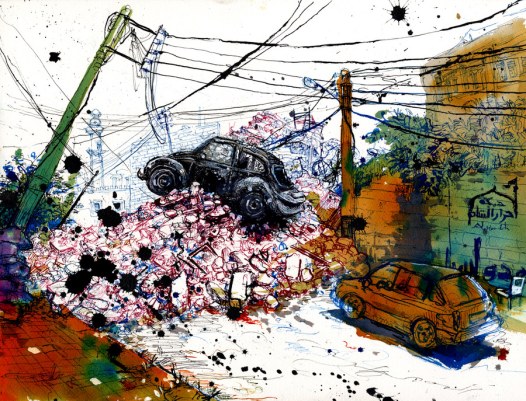
The remains of the Ayn Jalut elementary school in Aleppo, which was bombed on April 30, 2014. Illustration by Molly Crabapple. (Source: Illustrator draws out Syrian life under Islamic State rule, pbs.org)
It is during this period in history, as I understand it, that native Syrians begin to rise in defense of their country, amidst Arab-Israeli wars and the Arab oil embargo. These conflicts, in combination with the long history of foreign rulers, is what I understand partially begins to fuel the source of extreme conflict in Islamic nations, leading to radicalism and revolution during the Russian invasion of Afghanistan. The next decade lures the United States to become even more involved in the Middle East during several conflicts, notably during the Persian Gulf War. By the 1970’s the U.S. becomes a significant target among Islamic radicals seeking to impose their extreme beliefs and rid their homeland of western inhabitants.
It’s sad. It’s perplexing that no nation, president, corporation, nonprofit, good Samaritan has ever merely looked at the country with potential and clear intentions to help it stand on its own. Has that ever been the intention of U.S. government involvement? Has any nation or individual pursued this cause in Syria? It’s not a rhetoric question. I ask wanting to know and welcome anyone who feels inclined to share. A friend of mine responded that current President Bashar al-Assad is the native “good Samaritan” that stepped up to lead his country- now there seems to be evidence of his abuse of power (to put it lightly).
I’ve tried to think through what can be done- provide aid to promote a stable and sustainable economy for example. Agriculture is one of Syria’s primary sources of income, but even access to safe drinking water is a challenge. Oil production has reached its peak, and they now have to import it. A combination of renewable energies like wind and solar could probably bring about a great deal of positive change. But when you have reasoned through all the ways the country can be supported and brought back to a peaceful state, you still have to heavily consider that the fate of the Syrian people is ultimately tied to what is happening in all Isis-gripped nations.
The Principle
So many layers to peel back here. So what’s the principle of the matter- the right to sovereignty? Entitlement of powerful nations? Greed disguised as aid? I’m at a loss on this one. You can lead a horse to water, but you can’t make it drink.

 Based on Principle
Leave a comment